A strip of land for a grave
- Published
- Topic
- Literature
- Reading time
- 4 min
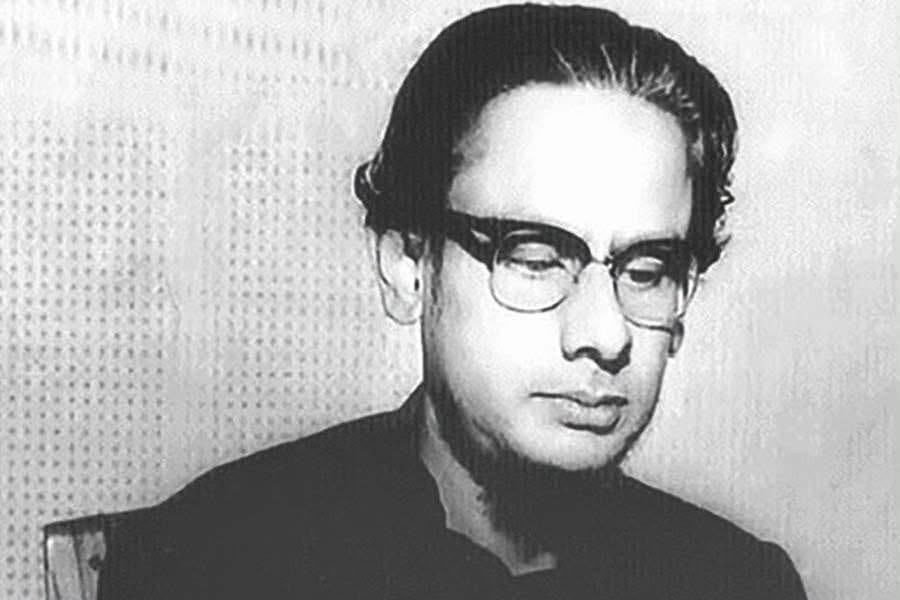
A young man was studying medicine and had to stop halfway for want of money. Not ordinary want: such hardship that the whole family went half-fed or unfed. A daughter died untreated because there was no money.
It is impossible to imagine what it costs a father to carry his dead child to the graveyard because he could not pay. He fell ill himself and died not long after.
He got no proper treatment in his illness before he died. It was Ramadan. In extreme illness and want, he kept the fast on water alone. He died on the 27th of Ramadan.
This is not the story of a character in fiction. It is the end of the life of Farrukh Ahmad, poet of ‘Sat Sagarer Majhi’, The Boatman of the Seven Seas.
A father of six, Farrukh Ahmad was hardworking and self-respecting all his life. Newly married, he had enrolled for a BA and left his studies to support his family, because by then his father, a police inspector, lay on his deathbed with the illnesses of old age.
The charge his detractors lay against him is that he wrote poems for the Pakistan movement. Seen another way, that makes him a fighter in the movement against British rule.
He became a thorn in the eye of many of this society’s sham progressives. Leaving the armed communist politics of his youth, he spoke of the victory of Islam rising from Hira. In his lines:
“Let the orange leaves fall in this storm, the leaves are countless still,
where they crowd, the royal gate of Hira wakes in the sky.”
He campaigned for Pakistan but never accepted the injustice of Pakistan’s rulers. He joined the Language Movement. He said that denying Bangla the status of a state language would amount to destroying Islam’s tahzib and tamaddun, its tradition and culture.
He was the first to argue, in Islamic terms, for making Bangla a state language. He accepted the Pride of Performance in 1965, but the very next year, when the Ayub government wanted to give him the Sitara-e-Imtiaz, Pakistan’s third-highest civilian honour, he refused it.
He said a poet has nothing to take from the arrogant in power. By then the great movement against Ayub had begun in both halves of Pakistan. He stood not with the red-eyed ruler but in the ranks of the protesting people.
And yet that same year, the Sitara-e-Imtiaz he had refused was accepted by the late Munier Chowdhury.
Farrukh wrote ‘Raj-Rajra’ to mock Pakistan’s rulers. Before independence it was staged under the direction of Munier Chowdhury, head of the Bangla department at Dhaka University.
During the Language Movement of 1952, in protest at the police brutality and the shooting of students and the public, he and his colleagues shut down every broadcast of Radio Pakistan.
The Pakistan government took away Farrukh Ahmad’s job for it. But faced with protests and a continuous strike by the staff, the government was forced to reinstate him.
He lost his job once more in his life. That time it was in newly independent Bangladesh, and it plunged the poet into ruin. He died on 19 October 1974. It was the evening of Shab-e-Qadr.
I have heard that two weeks after his death, a newspaper in Hong Kong wrote that the poet had died of starvation.
Shortly before his death, after the criticism it drew, he had been given back a job in the radio’s commercial service. But under the weight of debt, the grief of losing a child and severe illness, he died untreated.
Even after his death, despite many efforts, not a strip of government land could be found for the grave of one of the greatest poets of the Bangla language. In the end he was buried in the family graveyard of a friend.
Those who thought he would disappear if they took away his job and denied him a strip of earth to lie in were wrong. Farrukh is here, and will remain, in every awakening and every prayer of the Muslims.
After the fall at Palashi came the fall of Bengal’s Muslims, and a communal purge of the Bangla language by the caste Hindu elite. He wanted to lift the Bangla of East Bengal’s Muslims out of that, and to build an independent literary ideal for Bangla.
In the words of Professor Dr Ahmed Sharif, the ideal of Farrukh’s dream was this: ‘its ideal will be the teaching of the Quran, its vessel faithful to Muslim heritage, its subject the individual or society, or in the widest sense the world and life. In this way our national literature and national life will be built.’
This great poet, who sounded the call for a Muslim renaissance: has he been kept from us deliberately? So that the voice of that renaissance never reaches the hearts of Muslim youth, fallen generation after generation?
Farrukh was born on 10 June 1918 in the village of Majhail in Magura. He died at just 56, on 19 October 1974. Yesterday was the anniversary of his death.
Why is it that even on the day of Farrukh’s death, like ‘a strip of land for a grave’, the media of this country cannot find ‘a little space’ for the poet?
Why is this legend of Bangla poetry kept ‘untouchable’?